Open Wide the Door!
The Azusa Street Revival at 120
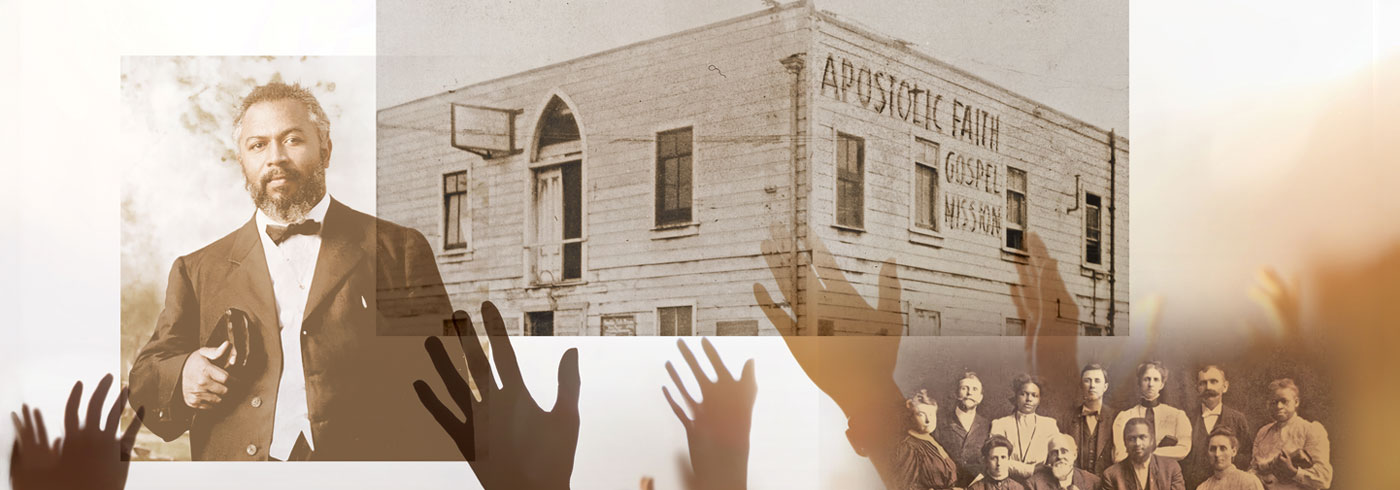
The Azusa Street Revival began on April 9, 1906, in Los Angeles.
There, as Pastor William J. Seymour prayed humbly behind a makeshift pulpit, the wind of God blew across the congregation, the city, the nation, and eventually the world.
Participants didn’t start the revival. They neither scheduled nor managed it, and they certainly couldn’t contain it. Instead, they simply opened the doors of their hearts and let the Holy Spirit move in — not as a guest, but as a resident.
Guest vs. Resident
Guests occupy spare rooms and live out of suitcases. They are uncertain of their welcome, careful not to intrude, and always conscious of the boundary between their space and that of the residents.
Residents, on the other hand, are woven into the fabric of a household’s daily life. They are present at the table, involved in making decisions, and trusted with house keys.
Many of us open the door to the Holy Spirit, but only as a guest. We acknowledge His presence on Sundays, invite Him into our crises, and call on Him for comfort and direction.
The men and women of Azusa Street took their doors off the hinges. They said, “Lord, live here. Not just in prayer meetings or when we’re in crisis — but in every room, every decision, every moment.”
Everything changes when the Holy Spirit takes up residence.
As we mark the Azusa Street Revival’s 120th anniversary, let’s also recall that God is not nostalgic. The Spirit rarely repeats the exact pattern of earlier revivals. Our spiritual heritage is a gift, not a blueprint.
Even so, I believe we can learn four things from Azusa Street that will position us for a profound move of God in our own day.
1. Hunger for God
Azusa Street was not built on personality or preaching. It was driven by hunger — an insatiable desire not just to know about God, but to know Him. Not just to hear about God, but to hear Him.
Revival participants longed for God in all His fullness — hence the phrase “full gospel.”
In a congregation, spiritual hunger typically begins with spiritual leaders. To those of us charged with that leadership, I ask: How hungry are we for God? Do we still crave His presence?
I never want to become self-sufficient in ministry. I need the anointing.
Busyness is not revival. Complexity is not anointing. Activity is not intimacy. Many spiritual leaders today are exhausted from doing ministry and have quietly lost their hunger for God.
Expectations, governance, and administrative overload can pull us away from prayer and the ministry of the Word (Acts 6:4).
At Azusa Street, when the Spirit moved, people responded. They feared grieving the Spirit more than missing an appointment. The whole place was steeped in prayer. The presence of God was manifest.
Hunger creates responsiveness. Responsiveness creates expectancy. Expectancy makes room for visitation.
Will you allow the Holy Spirit to baptize you with a renewed hunger for God?
2. Barrier-Breaking Love
Among the most stunning features of the Azusa Street Revival were torn-down walls of race, class, gender, education, and denominational affiliation.
Long before the Civil Rights Movement, Azusa Street modeled multiethnic, integrated leadership. The official publication, The Apostolic Faith, didn’t even list an editor because the publishers wanted God to receive the glory, not them.
Azusa Street reminds us that when ordinary people give the Holy Spirit access, God accomplishes extraordinary things through ordinary means.
What would happen in Pentecostal churches today if our social media feeds focused more on God than preachers?
Azusa Street’s watchwords were love, faith, unity, and humility. Those values broke barriers.
I am grateful the Assemblies of God continues to grow in racial and cultural diversity — though there is always room for more growth.
There are other barriers threatening our unity, however, and we need the Spirit’s help to overcome them too. For example, if we are not careful, the older generation will guard tradition, while the younger generation will chase innovation. If they refuse to work together, both will miss revival.
Revival flows where unity exists. We don’t need uniformity, but we must have honor. Revival cannot flourish where suspicion and discord live.
When you enter a place where the Spirit is evident, exalting Christ is always a priority. He gives us Kingdom perspective. And God’s kingdom always bridges human divides.
3. Unwavering Biblical Commitment
Azusa Street was experiential, but not experienced-driven. One early leader said, “We believe the Spirit does not go where the Word does not permit.”
As Pentecostals, we must be Word-based, Word-taught, Word-governed, and Word-influenced.
On the Day of Pentecost, Peter anchored believers’ experience in Scripture: “This is what was spoken by the prophet Joel” (Acts 2:16).
The Spirit and the Word are companions, not competitors.
In a culture that relativizes truth, Spirit-filled believers must know the Bible. A biblical worldview interprets reality through the filter of God’s Word — not cultural trends.
If we lose the Word, we lose our witness.
4. Intentional Missionality
Baptism in the Holy Spirit is not a spiritual souvenir. Too often we reduce that sacred experience to a moment to remember instead of power to live.
Believers at Azusa Street did not seek the Spirit merely for an experience, but for empowerment.
Acts 1:8 is clear: “You will receive power … and you will be my witnesses.”
The emphasis should not be on the experience itself, but on the result of the experience. The Spirit’s intent isn’t just to move us emotionally, but to mobilize us evangelistically.
From Azusa Street came missionaries, evangelists, church planters, and workers who took the gospel around the globe. Today there are well over 600 million Pentecostals worldwide, a population projected to reach 1 billion by 2050!
Even with the phenomenal growth of Pentecostalism, however, unreached people groups comprise 49% of the world’s population. The Holy Spirit dwells within us to empower us so that all people may know Christ.
If we redefine Pentecost as a moment instead of a mission, we have misunderstood it.
Permanent Residence
The same Spirit who fell on the Azusa Street Revival is present here and now. He has neither grown tired, nor has His power been diminished. He is not waiting for a better generation or more qualified people. He is looking for an open door.
Imagine waking up tomorrow morning and every morning thereafter, constantly reminded of God’s promises, continuously aware of Christ’s presence, and daily growing in trust of the Spirit’s guidance. Such a life is not reserved for a select group of believers. It is God’s desire for every Christian.
It starts with a willingness to say, “Holy Spirit, don’t just visit my life. Live here. Make Your home in me. I give You access to do Your transforming work in every room of my life.”
Azusa Street reminds us that when ordinary people give the Holy Spirit access, God accomplishes extraordinary things through ordinary means. A broken-down building becomes the birthplace of a worldwide revival. A humble gathering becomes the headwaters of a river still flowing today.
The question is never whether the Holy Spirit is willing to reside in you. It is whether you are willing to let the Spirit in.
Open wide the door!
This article appears in the Spring 2026 issue of Influence magazine.
Trending Articles
Influence Magazine & The Healthy Church Network
© 2026 Assemblies of God