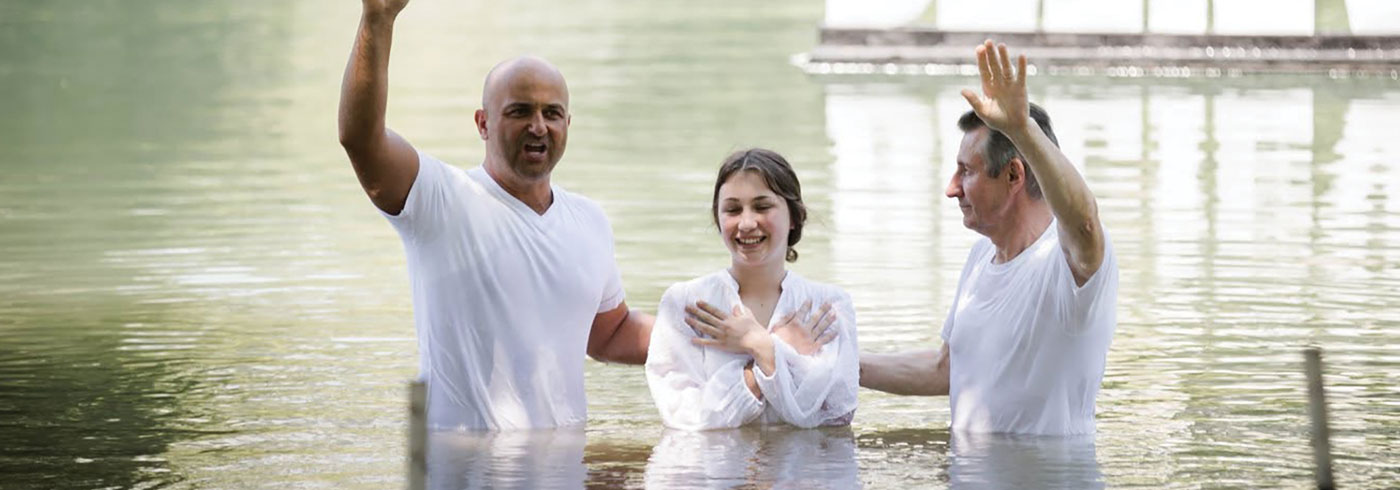
Children of the Persecuted Church
Slavic Pentecostals have survived — and flourished
Throughout much of the 20th century, it was common for American Pentecostals to pray for fellow believers who suffered in communist lands. Today, many Christians from the former Soviet Union live in the U.S., including Slavic Pentecostals.
The theology of Slavic Pentecostals is closely intertwined with the Assemblies of God. Their worship style is rooted in the Molokans of the Caucasus, the Mennonites of southern Ukraine, and the Baptists of the Soviet Union.
More than 500,000 Slavic evangelical and Pentecostal Christians fled religious persecution and settled in the United States. Family growth amid high rates of church retention have increased their ranks. Slavic Pentecostals in the U.S. now number an estimated 1 million.
Across the nation, these Pentecostals are represented in over a dozen Slavic church unions (federations), numerous independent Slavic churches, and diverse American congregations.
Slavic ministry leaders and scholars estimate there are 900–1,200 Slavic American Pentecostal churches in the U.S. Some are large, with thousands of attendees and expansive buildings. Others are small, meeting in homes.
The largest union is the National Slavic District. With 96 churches and 30,000 baptized adult members, it is the fastest growing district or network in the Assemblies of God.
Spirit Baptism
Slavic Pentecostalism in America dates to the early 20th century, when immigrants from Eastern Europe and the former Russian Empire began experiencing baptism in the Holy Spirit with the evidence of speaking in tongues.
A key figure in the formation of this movement was Assemblies of God missionary and martyr Ivan Voronaev (1885–1937). Voronaev was a Russian Baptist preacher and magazine editor living in New York City when he encountered Pentecostalism.
In 1919, Voronaev’s 10-year-old daughter, Vera (meaning “faith” in the Russian language), started attending Pentecostal services at Glad Tidings Tabernacle Assembly of God in New York along with her friend Anna Sirets.
Voronaev’s wife, Ekaterina (1887–1965), recalled how God used the little girl for a great revival:
My husband said to me, “Don’t let Vera go to the meeting anymore, because the Baptists will excommunicate me for going to an American church and praying for Baptism.”
He left, and the girl knew nothing and went to the meeting, and on that day the Lord baptized her with the Holy Spirit. My husband returned on Monday, and she said, “Papa, the Lord baptized me with the Spirit!”
He took her in his arms, wept, and said, “Vera, pray that the Lord baptizes me too!” — and went to the Baptist meeting and said, “Brothers and sisters, I am leaving the congregation. Spiritual baptism has been revealed to me!”
And they replied, “We all believe! We all leave!” And the Baptist congregation emptied.
Nineteen people left with their pastor and formed the first Russian-speaking Pentecostal congregation in the U.S.
Voronaev became an Assemblies of God missionary and, in obedience to a prophetic word, gathered a team of ministers to evangelize their homeland. They arrived in Istanbul, Turkey, during 1920, baptizing the first Russian converts in water.
The team then preached in Bulgaria for a year and founded seven churches. In 1921, Voronaev arrived in Odessa, Ukraine, which had been devastated by the Russian war against Ukraine (1917–21).
Despite famine, spiritual opposition from other evangelical churches, political obstacles, and extremely limited finances, Voronaev’s ministry bore abundant fruit over the next nine years. More than 1,000 churches and groups were established across the newly formed Soviet Union, over 35,000 converts experienced water baptism, and thousands of people answered the call to ministry.
This golden decade of gospel proclamation came to an end in 1930, when Voronaev and approximately 800 other Pentecostal ministers were arrested. Many never returned home.
Voronaev was executed on Nov. 5, 1937. Ekaterina was arrested in 1933 and spent more than 20 years in Soviet prisons and labor camps. Friends rescued their six children and took them to the U.S.
Meanwhile, another Assemblies of God missionary — Gustav Herbert Schmidt (1891–1958) — helped lay the foundation for Pentecostalism in western Ukraine and Poland. Schmidt’s Bible school in Danzig (now Gdansk), Poland, and his publications were influential across Eastern Europe during the 1930s.
Underground Church
Baptist and Pentecostal churches in the Soviet Union partly resumed their ministry during World War II. In 1944, Joseph Stalin permitted restoration of the Baptist Union, and the following year approximately 20,000 Pentecostals were incorporated into it.
Despite famine, spiritual opposition from other evangelical churches, political obstacles, and extremely limited finances, Voronaev’s ministry bore abundant fruit.
Secret police surveillance, along with rules banning praying in tongues and praying for healing, provoked internal disagreements within the All-Union Council of Evangelical Christians-Baptists. In 1948, a group of Pentecostal ministers withdrew and created an unregistered, or illegal, union of Pentecostal churches.
Ministers in the underground church risked incarceration and execution for their faith. Theological education was forbidden.
Government agents infiltrated religious organizations, arresting believers. Thousands of Christians were sent to prisons, labor camps, and psychiatric hospitals. Children were taken from parents and placed in orphanages.
In the early 1930s, following a revelation from the Holy Spirit, Alexander Shevchenko helped lead more than a thousand Pentecostals from the Soviet Union to China. Traveling in groups, they made their way from China through the Philippines, Australia, Uruguay, and Paraguay — until in 1958 they reached the shores of California.
Pentecostals who remained in the Soviet Union clung to the belief that God would vindicate them, judging their persecutors as He did the leaders of ancient Babylon.
Based on their understanding of Scripture and prophetic utterances circulating within the underground church, these believers expected the Soviet Union’s collapse. They prayed for and anticipated open borders and freedom to preach the gospel.
Iron Curtain Opens
By the mid-1980s, totalitarian corruption, economic struggles, and civil unrest had driven the Soviet Union to the brink of collapse.
The U.S. Congress passed the Lautenberg Amendment in 1989, allowing religious minorities from the Soviet Union to obtain refugee status by demonstrating only a “credible, though not necessarily individualized, fear of persecution.”
This was a significantly lower threshold than standard American immigration requirements. The vast majority of early religious refugees arriving under that provision were Pentecostals.
After the U.S.S.R. dissolved in 1991, a multitude of missionaries rushed to preach the gospel in former Soviet lands.
World-renowned pastors and evangelists — such as Billy Graham, David Yonggi Cho, and Reinhard Bonnke — held massive evangelistic campaigns.
Pentecostal churches that were previously underground launched their own evangelism efforts, making many converts.
Burgeoning churches and the influx of Western missionaries created significant cultural tension. Many Slavic Pentecostals took issue with Western worship styles and certain theological ideas. For example, when prosperity preachers promised health and wealth to those with enough faith, those claims rang hollow to believers whose deep faith had led to persecution.
Slavic Pentecostals split into two camps: “conservative” and “charismatic” churches. The latter reflected Western styles, such as contemporary music, freedom in clothing and appearance, and expressiveness.
The conservative wing, by contrast, was characterized by modesty in dress, head coverings for women, large families as the norm, traditional musical styles, suppression of applause and movement during worship, and rejection of female pastoral ministry.
New Homeland
Since 1988, hundreds of thousands of Slavic Pentecostals have arrived in America. The largest concentrations of this diaspora settled in Sacramento, California; Portland, Oregon; Vancouver, Washington; Seattle; Atlanta; Charlotte, North Carolina; and Spartanburg, South Carolina.
While Slavic Pentecostals are present in every state, they tend to cluster in groups. Following Russia’s invasion of Ukraine in 2022, thousands of Pentecostal Ukrainian refugees fled to the U.S., strengthening existing congregations and forming new ones.
Contemporary Slavic Americans, known for their hard work, often run successful businesses, enabling them to give time and money to local church ministry and foreign missions.
Most Slavic churches are led by elders, from among whom pastors are elected. Pastors are typically bivocational — even in large, prosperous congregations — and churches cultivate a broad base of lay leaders.
Slavic American Pentecostals tend to be conservative in ethics and doctrine, but their worship styles vary greatly.
Some congregations have started English language services to meet the needs of younger generations, blurring conservative and charismatic distinctions. These services are attracting growing numbers of non-Slavs, who appreciate the deep faith, strong families, and sense of community they find among children of the persecuted Church.
Like long-lost cousins, Slavic and American Pentecostals have been rediscovering their common roots and faith while forging friendships.
What began in 1919 with a 10-year-old girl’s testimony to her father about being baptized in the Holy Spirit has become part of a worldwide Pentecostal revival.
This article appears in the Summer 2026 issue of Influence magazine.

Trending Articles
Influence Magazine & The Healthy Church Network
© 2026 Assemblies of God