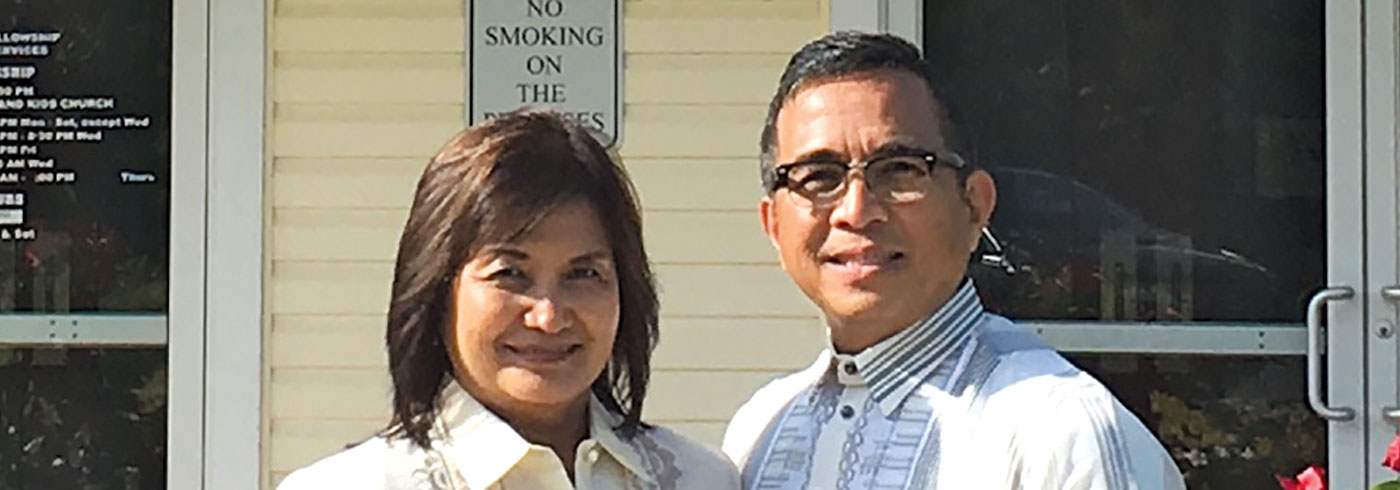
From Expatriate to Pastor
Nestor Arellano ministers across ethnic boundaries
Ernesto “Nestor” Arellano’s circuitous journey from the Philippines to the United States via the Middle East isn’t unusual.
As with many Filipinos, Arellano left his native land in search of an improved economic life. With a population approaching 117 million in the Southeast Asian archipelago country (according to 2025 United Nations data), going abroad for work is common.
“There is a Filipino diaspora population of 12 million, many of them born-again Christians working in influential places,” says Arellano, president of the Filipino-American Christian Fellowship, one of two dozen ethnic/language groups in the U.S. Assemblies of God.
Filipino expatriates work in a variety of fields, including medicine, engineering, construction, and the travel industry. Some, like Arellano, end up in ministry.
Despite his partying lifestyle and drug use, Arellano was successfully managing a coffee shop in his home country at age 21. That landed him an offer for a similar position in a Middle East nation.
The Muslim-dominated country to which Arellano moved restricted alcohol consumption and extramarital sex. Nevertheless, Arellano organized clandestine parties in a boarded-up house, where Westerners smuggled in alcohol.
“No one ever caught us,” Arellano says. “No one was imprisoned or deported.”
However, Arellano’s cohabitating Filipino girlfriend, Wilma, returned from a visit home talking incessantly about her newfound faith in Christ. Wilma started attending underground Bible studies and church services, inviting Arellano to join her. He made a point of getting drunk the night before just to avoid going.
Finally, Arellano relented, showing up at church while still reeking of alcohol. A pastor’s question during the sermon shook Arellano to the core: “If you die today, what right do you have to enter the kingdom of God?”
When it was time for the altar call, Arellano raised his hand to accept Christ.
As Arellano studied Scripture and grew in faith over the months that followed, his vices began to fall away. He and Wilma married.
Arellano eventually became a cell group leader, worship leader, and the youngest elder in the underground church.
The Arellanos returned to the Philippines, where they led an inner-city outreach to kids in the capital city of Manila. But like many in the Philippines, they had difficulty making ends meet.
Wilma, a trained nurse, accepted a three-year contract in 1993 to work in the U.S. After twice dreaming about ministering to people with various hair shades (unlike the uniformly dark-haired people in the Philippines), Arellano sensed the Lord calling him to plant a church in the U.S.
Jesus Is Lord Fellowship
(Assemblies of
God) in Toms
River, New Jersey,
started with eight
Filipinos meeting
in the living room
of the Arellanos’
apartment.
Jesus Is Lord Fellowship (Assemblies of God) in Toms River, New Jersey, started with eight Filipinos meeting in the living room of the Arellanos’ apartment. The congregation multiplied via small groups.
For 12 years, as attendance increased, the church moved from place to place before settling on a 12-acre farm during 2005. Construction on a new multipurpose facility started this year.
Early on, recently arrived immigrants, mostly in the medical field, comprised the congregation. But as they invited American friends and co-workers, Arellano’s vision of a multiethnic body of believers began taking shape. Today, 40% of the congregation’s 220 regulars are non-Filipinos, with 17 nationalities represented.
Having spent most of his 63 years in the U.S., Arellano’s experience parallels many Filipino Americans his age. While embedded in American culture, he also understands the culture and traditions of his homeland.
Young American-born Filipinos in the congregation are largely unaware of the customs of their ancestors. More than 4.1 million Filipino Americans live in the U.S., making them the third-largest Asian subgroup, after Chinese and Indian Americans.
The growth-through-diversity strategy at Jesus Is Lord Fellowship, and indeed Filipino American AG churches overall, is unlike many ethnic minority fellowship groups. One of the draws for non-Filipinos is that nearly all services are conducted in English rather than Tagalog or other native languages.
Ninety churches comprise the Filipino-American Christian Fellowship of the AG, many of them located along the West Coast. This summer, the fellowship held a three-day celebration in Sacramento, California, marking the 50th anniversary of the first AG Filipino church opening in the U.S.
“They’re building churches now that are very multiethnic,” says Dennis Rivera, national director of the AG Office of Ethnic Relations in Springfield, Missouri. “They knew that in order to stay vibrant as churches, they had to include the broader community.”
Rivera, who spoke at the anniversary commemoration, applauds the Filipino-American Christian Fellowship for a revitalized church planting vision, especially in urban areas. He notes that the largest congregation in the AG’s Northwest District is All Nations Church in Seattle, led by Filipino American pastor James Reyes. More than 40 countries are represented in the church body.
“Filipino American churches know the need to bring the next generation into the mission of serving and going and planting,” Rivera says. “From their home country, the Filipino diaspora has spread throughout the world. Lots of people who leave the Philippines do so with the purpose of being part of a church plant.”
Retiring New Jersey Ministry Network Superintendent Don James notes that as a network Filipino presbyter, Arellano helped minister to the melting pot of ethnic minority groups represented in the state.
“He’s a good communicator and a team player,” James says of Arellano. “He’s helped us minister in a stronger and better way to all our ethnic minority churches. I wish we had more pastors like him who can reach across ethnic boundaries.”
James says Filipino congregations tend to attract a variety of ethnic groups by offering English services and welcoming immigrants.
“Nestor has been great working across gaps for people not born and raised in the U.S.,” James says. “He understands from a cultural perspective what they have to go through when they move here.”
AG missionaries Benjamin and Cornelia Caudle introduced the AG to the Philippines a century ago. According to the World Assemblies of God Fellowship, there are now 16,219 AG churches and 753,986 adherents in that country.
This article appears in the Summer 2026 issue of Influence magazine.
Trending Articles
Influence Magazine & The Healthy Church Network
© 2026 Assemblies of God